
Richard Schneider and the Quest for the Perfect Tone
Lillian, the Kasha Guitar, and the Beginning of My Starwalker Quest
Detroit, Autumn 1969 I’m turning seven soon, and I’m spending a September Saturday with my father. We’re driving through the streets of the Motor City. Dad pulled up to a nondescript warehouse-like building, parked the car near Harper Avenue, and we stepped out into a fall Saturday morning. On the drive over, I remember seeing a billboard announcing the Beatles' new song, Here Comes the Sun. For reasons I still can't explain, the image of the rising sun lodged itself permanently in my memory. Even now, the memory lingers, as if the soundtrack of that moment was already written.
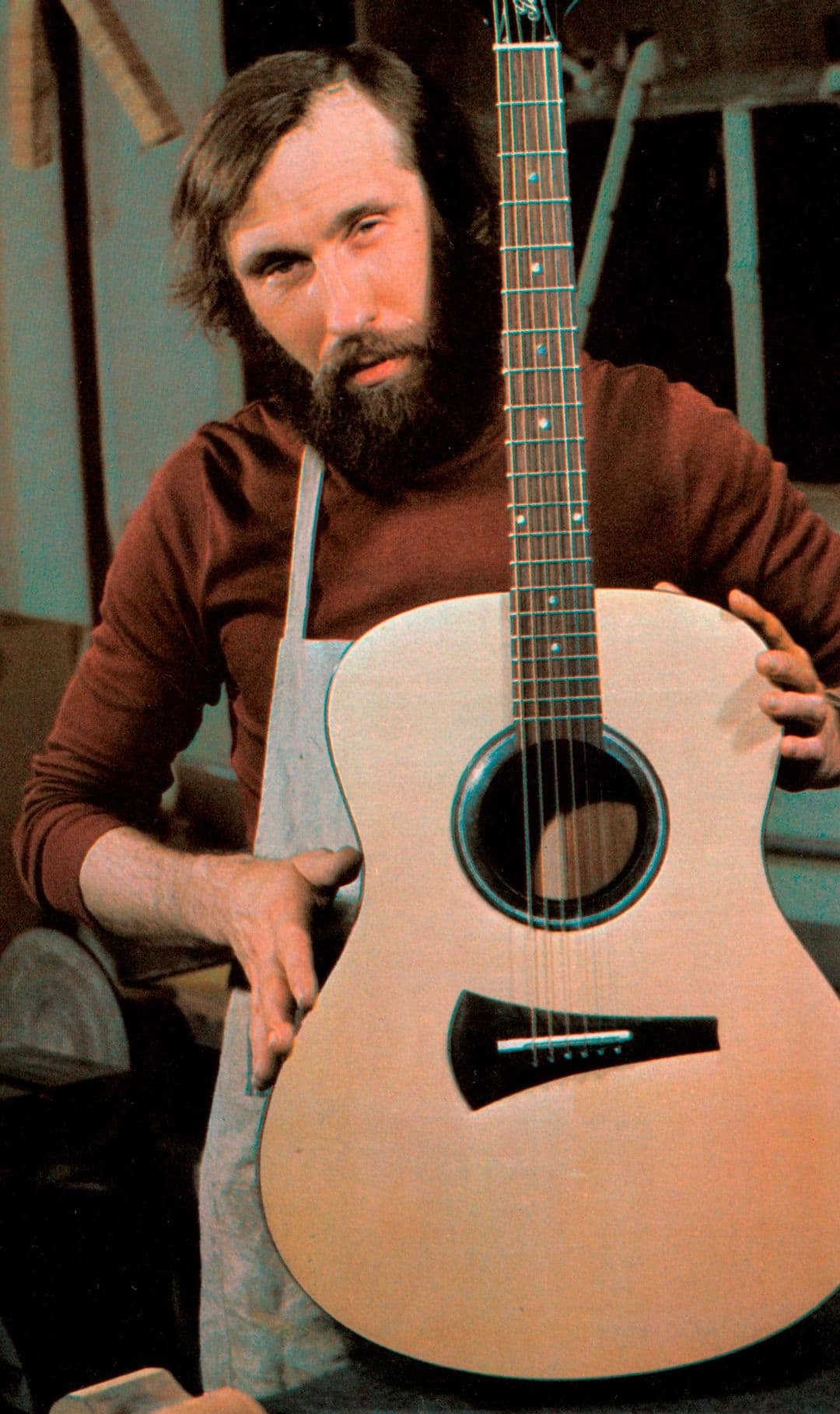
Dad knocked on the building's door. When the door opened, a lanky, bearded man of about 40 with squinting eyes appeared. I could tell this was going to be fun.
Inside, the air of the studio was warm and thick with a scent I would never forget, spruce, cedar, rosewood, maple, varnish, and sawdust. It smelled a bit like the evergreen forest of northern Michigan had been brought indoors and transformed into music.
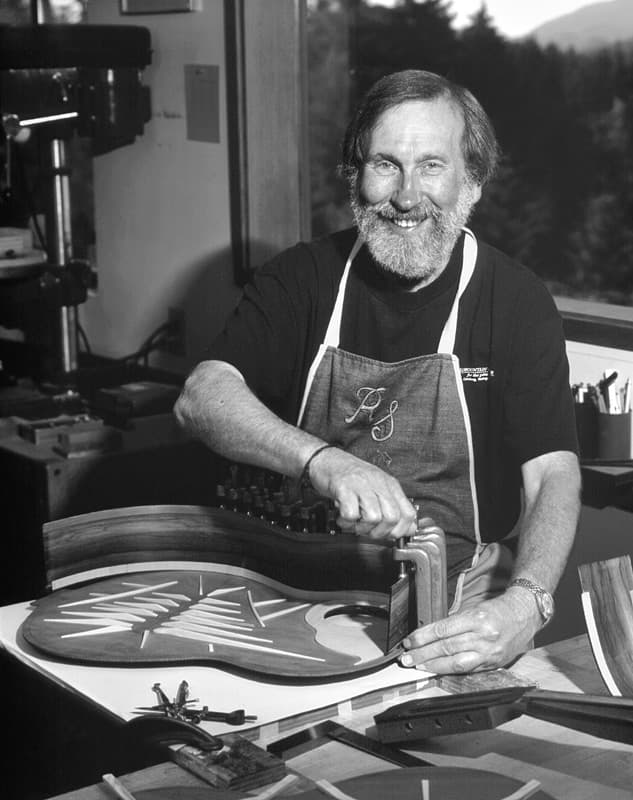
This was Richard Schneider's guitar studio.
To the guitar world, he would become known as one of the most innovative luthiers of the twentieth century. But to our family, he was simply Uncle Dick.
That workshop in Detroit was one of the first places where I encountered the quiet magic of craftsmanship, mastery, and tone, as well as the quest to push boundaries, and perhaps the deeper human longing to bring the invisible into form and make the impossible possible..
A Wonderland of Old World Magic
To a boy, Richard’s studio felt like a wonderland. Magic hung in the air. The aroma of elixirs. Rare tone woods were stacked everywhere and high. Light streamed in from the warehouse like windows. In progress guitars hung from the walls. Thin spruce soundboards leaned against the wall. In Richard’s hands dark Brazilian rosewood backs shimmered with swirling grain patterns that looked almost like galaxies frozen in wood.
Richard put the rosewood down and stood at a bench wearing an apron and a jeweler’s eyepiece, patiently showing my father how he assembled a rosette made from hundreds — perhaps thousands — of tiny pieces of colored wood. Fuchsia, pink, green, and purple. Put together, the effect was psychedelic.
Every so often, he would pause and tap a piece of wood with his knuckle.
Then he listened.
Only later did I understand what he was doing.
He was listening for resonance, the hidden voice inside the wood.
Even then, I sensed that something extraordinary, even spiritual, was happening.
Wood was becoming music. My Uncle Dick was a like a wizard!
For our family, Richard was more than a guitar maker. He was part of our lives. Family. Whenever he visited our house, it was alive with possibilities and fun.
He sang children’s songs to my sisters; his folk style reminiscent of Paul Stukey.
He accompanied us on weekends “up north.” I have a vivid memory of Richard’s lanky 6 ‘ 4” frame s-t-r-e-t-c-h-i-n-g out from a fallen tree bridging a spring to scoop up a jug of spring water for his Jack Daniels and the amazingly beautiful woman in his company.
When I painted a heavily modified Gibson SG, later signed by Eddie Van Halen in 1979, Richard supplied the paint straight from Gibson’s stash and marveled at the idea of Frankensteining a Gibson this way.
The Detroit Legend
Richard Schneider was practically a legend in Detroit guitar circles. If The Rolling Stones were playing in town, tickets were abundant. Apparently, Keith was a fan.
Richard had trained in Mexico with master luthier Juan Pimentel, absorbing the classical Spanish tradition of guitar building. His work eventually attracted the admiration of the great Spanish virtuoso Andrés Segovia, who once wrote:
“To Schneider, in whose hands lay the future of the guitar.”
Yet Richard was not content simply to preserve tradition.
He wanted to reinvent the guitar itself.
Lillian: The First Dream
In 1972, in that Detroit workshop, Richard built a guitar that would become part of my family’s story.
He named his guitars after women he knew.
This one he called Lillian.
Lillian was my mother’s middle name. She lent it to the guitar.
But Lillian was more than a guitar.
It was the beginning of a dream shared by three men:
Richard Schneider, the master luthier
Dr. Michael Kasha
and my father, who financed the project.
Together, they set out to build a guitar from the ground up based on the physics of sound. Lillian became the first Schneider-Kasha guitar.
Harmonics in Our House
My father was deeply invested in harmonics. Our home rang with discussions of tones, rings, resonance, vibration…and guitars. Church on Sunday was Johnny Cash, Kris Kristofferson, Waylon Jennings, and Merle.
One of his ventures involved physicists at Penn State University’s, and a rather unusual man, who were exploring an extraordinary idea: extracting gold from seawater using harmonic separation.
On my father’s desk sat a book titled The Symphony of Life, a gift from the unusual one, who told him this book contained the key to everything. I swear, that man was an alien. All the other scientists whispered so, anyway. I mean, who else has an idea to clean the world’s oceans or treat sewage with sound? Or, even more fantastically, coax gold out of seawater?
Interestingly, as I would later learn, in 1976 author Zecharia Sitchin proposed ancient Sumerian myths say extraterrestrials known as the Anunnaki came to earth in search of gold and attempted to use this exact process.
For a while, the research was promising. The results were positive. They proved they could tune seawater with sound and mine gold. They could also treat raw sewage with sound and get fresh water.
Then the FBI called.
Apparently, using harmonics to mine gold from seawater was not something authorities wanted happening in the mid-1970s.
My point is, sound was everywhere present in our home. The guitars were hidden. A ‘secret’ closet contained all the treasure a young boy could ever dream of. The ’58 Gretsch Roc Jet, the ’64 Gibson Dove, the ’64 Barney Kessell. I’d sneak in there every now and then. Then, one day, a wine-colored 1976 Les Paul that mysteriously appeared. Dad had some wood.
While my father’s hopes and dreams were all about resonance and the symphony of life, my mother lived in an entirely different world.
As fashion director for Saks Fifth Avenue in Detroit, she welcomed up-and-coming designers like Ralph Lauren, Mary McFadden, and Calvin Klein when they arrived in Motown. Often, she accompanied them on the local TV morning show fashion shows. Our family’s wood-paneled Oldsmobile station wagon served as her limo. My job was to keep it clean.
One could say our household existed at the creative intersection of physics/resonance, design/fashion, and music. There was found the gateway to possibility and wonder. Knowledge. Clothes. Tone. That’s it!
The Kasha Revelation
I sensed that something wondrous was happening with Lillian. Expectations were high. Word was out that Richard was at the center of the guitar universe and was rearranging the furniture. Well, the bracing of the guitar, anyway. Dr. Michael Kasha was the architect of this system.
Kasha himself was a remarkable scientist.
A molecular spectroscopist and founder of the Institute of Molecular Biophysics at Florida State University, he studied how molecules absorb and emit energy.
One day, he looked inside a guitar and noticed something surprising. The internal structure of the instrument — the bracing beneath the soundboard — was not acoustically optimized.
That realization sparked a flood of ideas.
Soon, he had developed a radically new concept for guitar design.
But Kasha was not a luthier.
He needed someone capable of building the instrument he imagined.
That person was Richard Schneider.
Their collaboration would last more than thirty years.
The Architecture of the Kasha Guitar
The Kasha–Schneider guitar reimagined nearly every part of the instrument.
Instead of traditional fan bracing, the soundboard used asymmetrical bracing that strengthened the bass side while allowing the treble side greater flexibility.
Some designs incorporated multiple soundholes rather than a single central opening.
Soundhole placement became flexible. Rather than just beneath the soundboard in the middle of the guitar they moved it around.
Others used a split bridge, allowing bass and treble strings to transfer vibration differently.
The soundboard itself was carved with varying thicknesses, carefully tuned so that different areas resonated more efficiently.
The goal was simple: to transform the vibration of the strings into sound as efficiently as possible.
The Gibson Mark Series
Eventually, Richard’s work caught the attention of Gibson Guitar Corporation, the Kalamazoo-based manufacturer of some of the world’s greatest guitars.
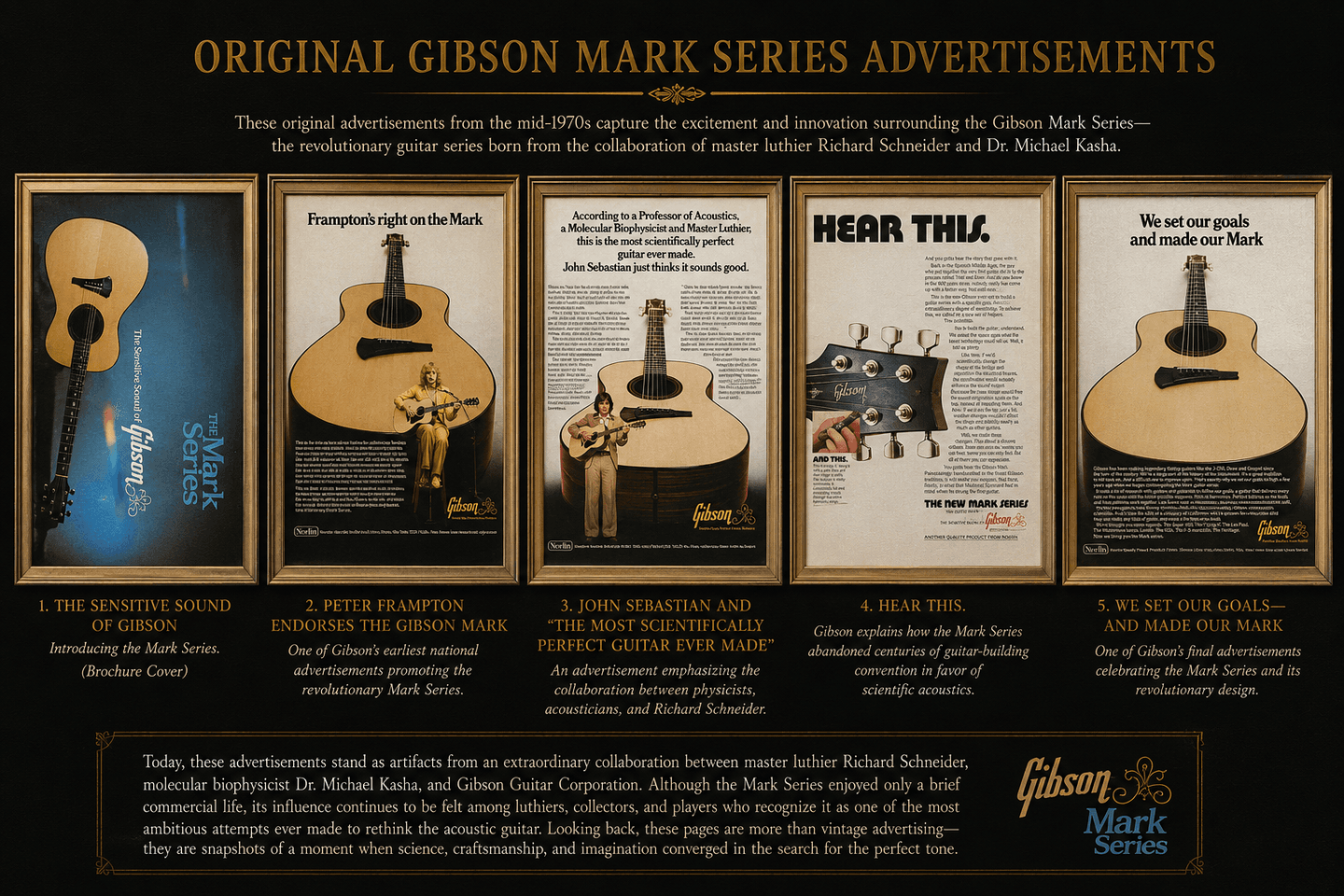
Gibson licensed the Kasha design and released it commercially in 1975 as the Gibson Mark Series jumbo dreadnought acoustic guitars.
The guitars were strikingly modern.
They featured offset soundholes, modified internal bracing, and a distinctive body shape.
Rock guitarist Peter Frampton, and singer songwriter, John Sebastian, even endorsed the instrument.
Yet despite its innovative design, the Mark Series became a sales failure.
The problem was not the design.
It was manufacturing.
Richard built his guitars by hand, precisely shaping each brace individually. Gibson struggled to reproduce that level of craftsmanship at scale.
Frustrations grew on both sides.
Richard was also a little frustrated that on the maiden voyage my father took Lillian out of her case and put a divot on the top, forever branding her gorgeous face.
The timing also worked against them. During the late 1970s, Gibson’s parent company, Norlin, was in turmoil and transitioning production from Kalamazoo to Nashville. (So, too, was my family.)
Innovation was difficult in those years. Richard would soon leave Detroit for Washington state to create his Lost Mountain School.
The Ultimate Les Paul
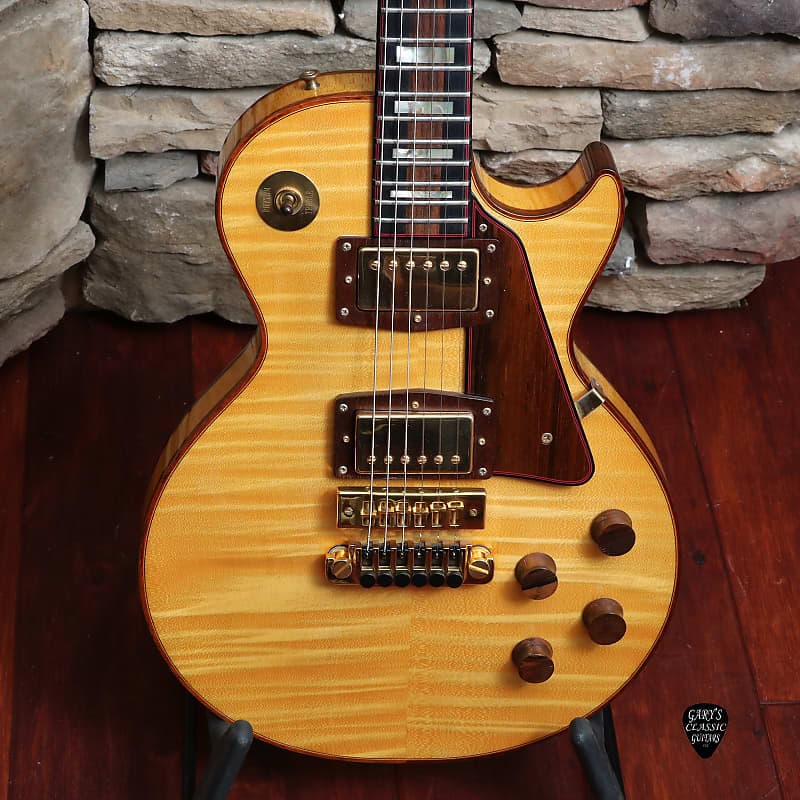
During this time Richard contributed to the design of a special instrument celebrating the twentieth anniversary of the Gibson Les Paul Custom.
The prototype, created in 1974, was intended to be the ultimate Les Paul guitar. He brought one of the first ones he built to our home. Opening the case and seeing this ultimate Les Paul was magical, even mythic beyond proportion. This was an historical instrument.
It featured hand done multi-colored binding, abalone inlays, and hand-carved wooden components—including pickup surrounds, pickguards, and control knobs.
Richard and his brother Donnie built many of these parts about a mile from the Gibson factory in Kalamazoo. The guitar sold for $3,000, an extraordinary price when a standard Les Paul Custom listed for $739.
Today, surviving examples sell for over $40,000.
The Fate of the Kasha Guitars
My father eventually owned three of Richard’s Kasha classical guitars, along with a fourth traditional classical. I learned to play guitar on one built by his brother, Donny. I still have it.
For decades, my father’s Kasha-Schneiders sat untouched in beautiful Mark Leaf cases, in closets. These queens demanded attention.
After my father passed in 2002, I brought them to Gruhn Guitars in Nashville. George Gruhn knew Richard well. He was utterly shocked, but elated, to see a few of his guitars pass through his world-renowned shop.
When he announced their availability, the guitars sold in hours. I bought a Peter Frampton Les Paul with part of the proceeds.
“Do you have more?” George asked.
Yes.
One more.
Lillian.
Do you want to sell it?
Never.
Lillian Comes to Phoenix
In December 2022, I moved to Phoenix. Lillian came with me on the flight from Nashville. When I opened the case after the flight, my heart sank. The neck had broken. Badly. What have I done? I wondered.
This guitar is my family legacy, but she has endured some experiences that have left her battered. After my father’s first ding, he left her in a case that was not fully closed. A hellacious Tennessee thunder storm ripped the roof of the room she was in and she got soaked. Now this.
Fortunately, a local luthier repaired the neck break using carbon fiber reinforcement.
Even though this was not her first repair I still felt terrible. Lillian is a historical instrument. I broke it.
Then, one night, Richard appeared to me in a dream. We talked about me selling his guitars and about what happened to Lillian.
“Thank you for setting my voice free,” he said.
I knew he meant the other Kasha guitars. The ones I sold. They were meant to be played, not entombed in closets.
Then he added something else.
“Don’t worry about the neck on Lillian. With that carbon fiber, it will never break again. It’s stronger than the day I built it.”
The relief was profound. So was the wonder. Was my Uncle Dick actually a wizard who could even appear in my dreams to ease my soul?
Finally, he said, “let your song be heard. Set your voice free, William.”
I knew what he meant.
The Starwalker Resonance
My song.
In my work exploring the Starwalker path, I often describe the universe as a field of harmonic intelligence—a cosmic symphony of vibration shaping matter, light, and consciousness.
A guitar demonstrates that truth beautifully.
Six strings vibrate.
Those vibrations pass through wood, into air, and into the human body.
Physics becomes emotion.
Sound becomes meaning.
Spirit awakens.
Soul is revealed.
In that sense, Richard Schneider was doing more than building instruments.
He was tuning matter to resonance, the symphony of life.
And perhaps that is the deeper lesson behind Lillian and the long quest for the perfect tone.
The universe itself may be a vast instrument, its strings stretched across space and time.
The Starwalker is simply the one who learns to hear its music.
Richard Schneider was not just part of my childhood; he was one of the most imaginative people I have ever known. He built a prototype for the world’s perfect guitar. (Today, I invest in prototype instruments.)
Whenever I pick up and play Lillian today, I think about something larger than guitars. I remember my Mother, my Father, Uncle Dick and their lifelong search for the perfect tone.
Looking back, I can see that resonance has been the hidden teacher of my entire life. Richard Schneider sought it in spruce and rosewood. My father pursued it through harmonic devices. The ancients encoded it into pyramids, temples, and sacred songs.
The Gospel of John called it the Logos, the creative vibration through which all things came into being. Every path I have followed, from the Kasha guitar to the Great Pyramid, from Mary Magdalene to the Starwalker mysteries, has been a search for this same living principle. Resonance is the bridge between matter and spirit, sound and silence, earth and heaven. When we become inwardly aligned with it, we discover that the universe is not silent at all. It has been singing to us from the very beginning. Looking back, I now realize that the search for the perfect tone and the Starwalker quest have always been the same journey.
Both ask a single question: How do we become resonant enough to hear the music already woven into creation?
About William Henry

William Henry is a Nashville-based author, investigative mythologist, and TV presenter. He is an internationally recognized authority on human spiritual potential, transformation and ascension.
He has a unique ability to incorporate historical, religious, spiritual, scientific, archaeological and other forms of such knowledge into factually-based theories and conclusions that provide the layperson with a more in-depth understanding of the profound shift we are actually experiencing in our lifetime.