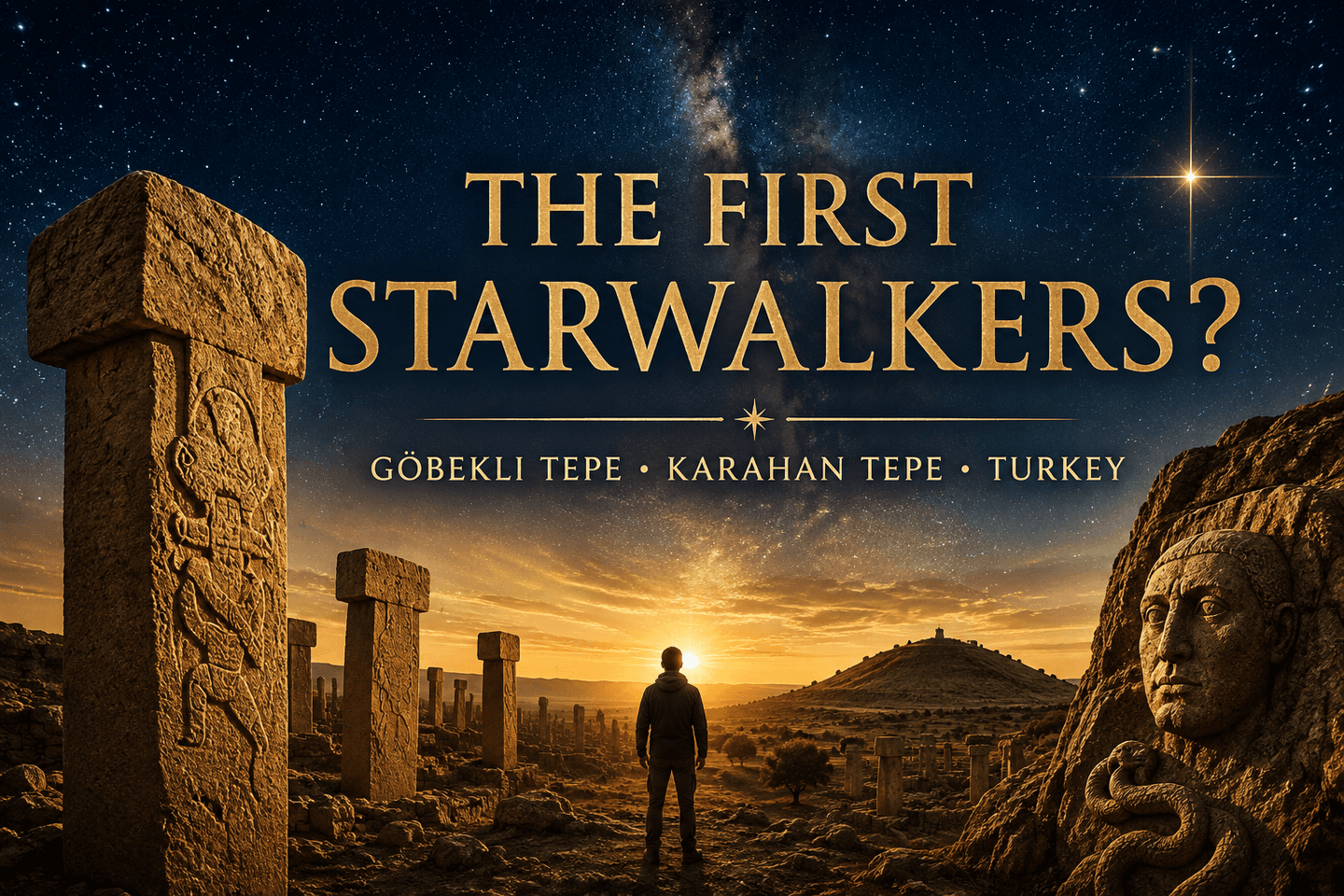
The First Starwalkers?
What I Am Going to Göbekli Tepe and Karahan Tepe to Find
Tomorrow, I am going to stand in one of the most mysterious landscapes on Earth.
I am traveling to southeastern Turkey to visit Göbekli Tepe and Karahan Tepe, two extraordinary prehistoric sites belonging to the wider archaeological region known as Taş Tepeler—the “Stone Hills.”
I am not going simply to ask:
Who built these places?
I want to ask:
What were they trying to become?
That question changes everything.
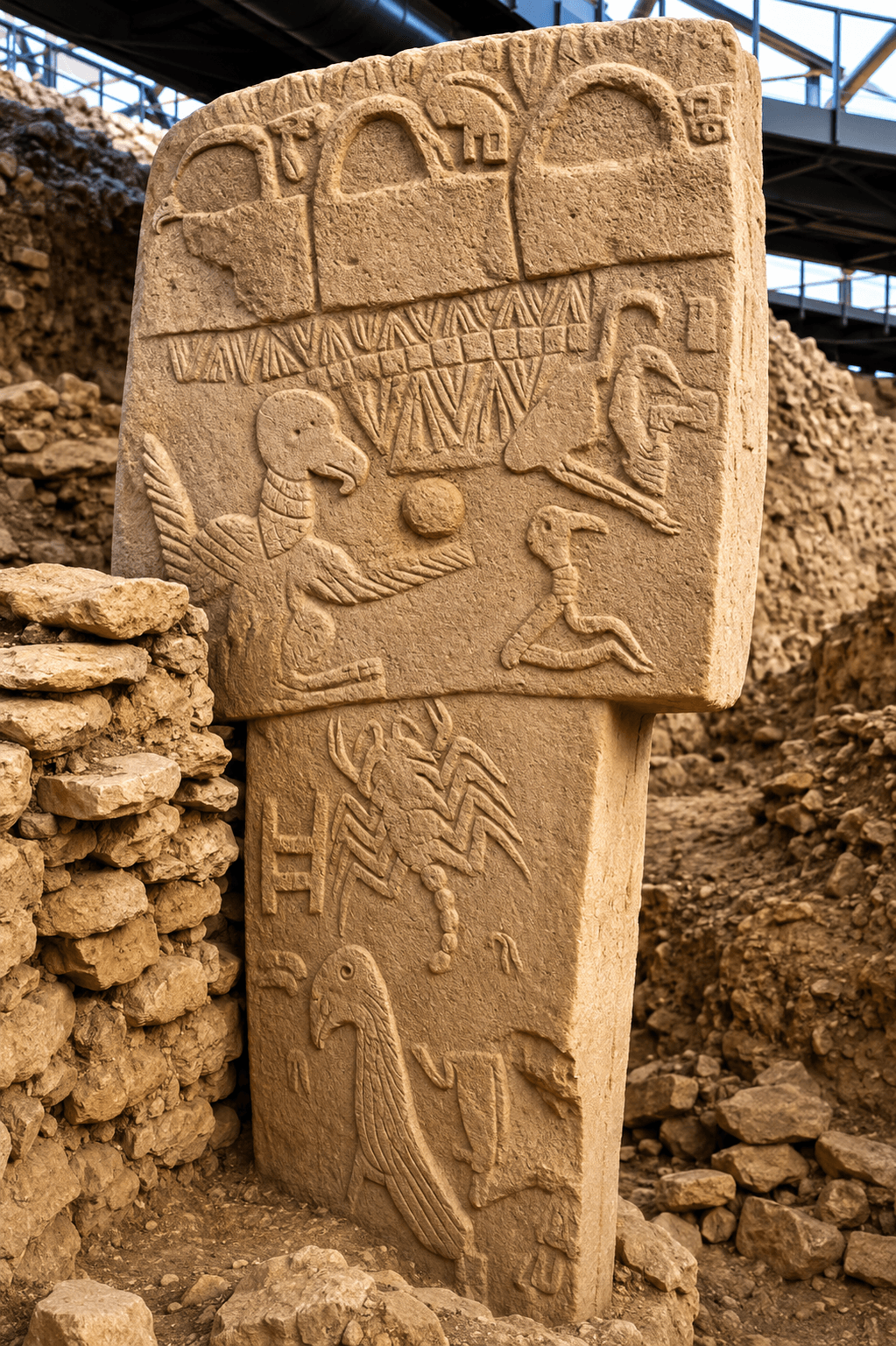
Because more than eleven thousand years ago people were erecting monumental stone enclosures filled with strange beings, serpents, birds, predators and enormous anthropomorphic pillars.
These people were looking at the sky.
They were entering specially constructed ritual spaces.
They were surrounded by images of creatures possessing powers humans do not possess.
And at Göbekli Tepe, some of the largest pillars are not merely stones.
They are beings. They have arms. They have hands. They wear belts. Some appear to wear garments. Yet they have no ordinary human faces.
They stand silently between categories: human, ancestor, spirit, god.
For decades I have followed what I call the Golden Thread—an ancient tradition of human transformation that runs through Egypt, Mesopotamia, Persia, Judaism, Christianity and other sacred traditions.
Its central message is astonishingly consistent:
The human being is unfinished.
We possess the potential to become something more.
A being of light.
A celestial human.
A being capable of crossing the boundary between worlds.
A Starwalker.
Now I am going to Göbekli Tepe and Karahan Tepe to investigate a provocative possibility:
Could the Golden Thread be far older than we imagined?
Could these mysterious sites preserve one of humanity's earliest monumental expressions of the dream of celestial transformation?
Not proof. Not a conclusion. A question. But perhaps one of the most important questions we can ask there.
THE PLACE WHERE HEAVEN ENTERED HUMAN CIVILIZATION
Göbekli Tepe and Karahan Tepe lie in southeastern Turkey, near Şanlıurfa and the ancient plain of Harran.
This region is extraordinary. It sits close to the world in which agriculture emerged.
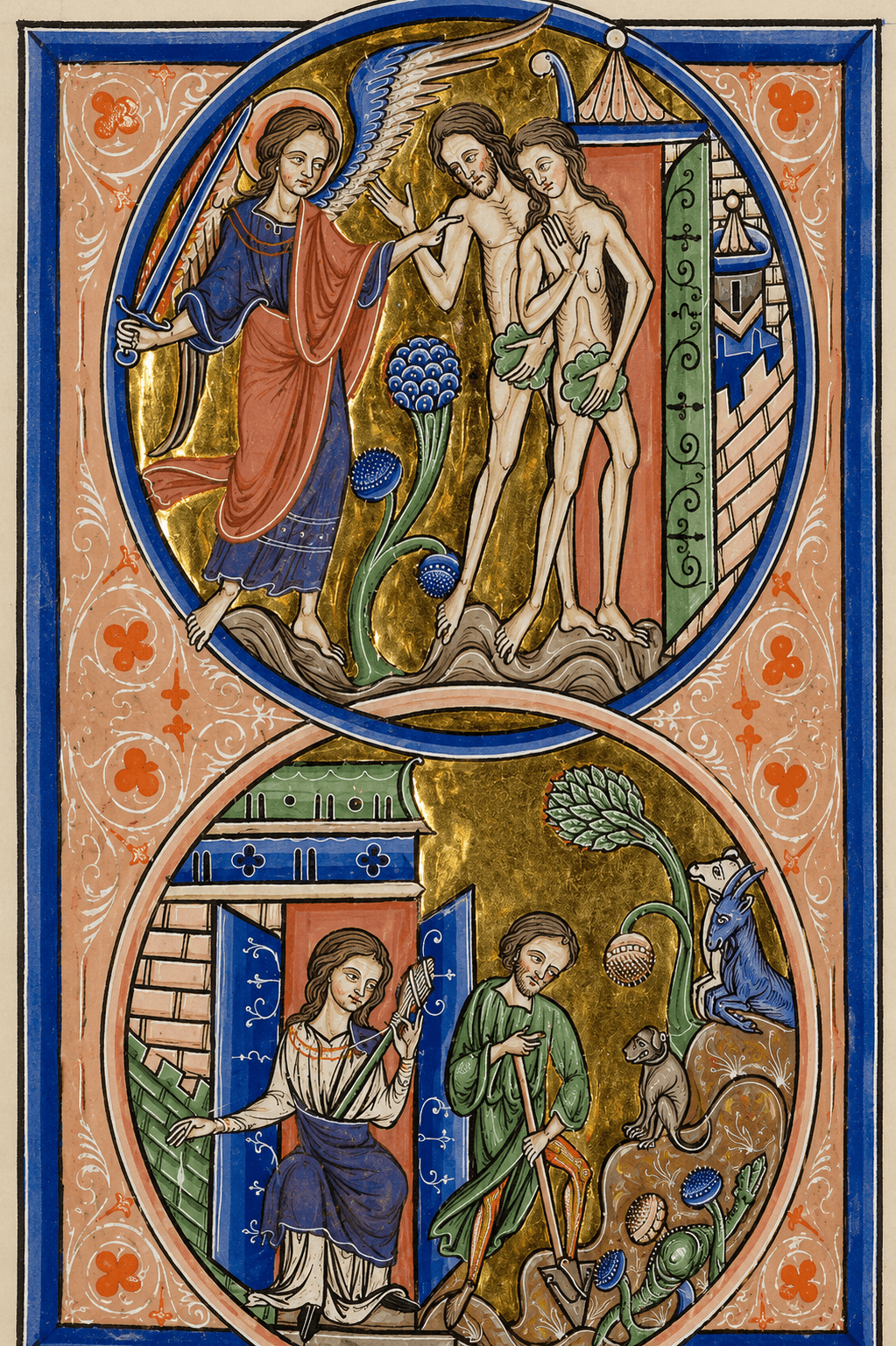
Turkish legend says Adam and Eve emerged from Eden at this exact location. In other words, the plain of Harran is the 'East of Eden' location where humanity stepped from Eden (located in the third heaven) to earth.
According to legend, Eve brought wheat with her from Eden. Adam brought a pomegranate and a rose bush with him. Adam plants the pomegranate and rose. When they become hungry, Eve reveals the heavenly wheat.
In the Mesopotamian myth “How grain came to Sumer” the brothers Ninazu and Ninmada, the servants of An, gift grain and flax to mankind. The story says:
“Men used to eat grass with their mouths like sheep. In those times, they did not know grain, barley or flax. An brought these down from the interior of heaven. An piled up the barley, gave it to the mountain. He piled up the bounty of the Land, gave the innuha barley to the mountain……… Let us go to the mountain, to the mountain where barley and flax grow; …… the rolling river, where the water wells up from the earth. Let us fetch the barley down from its mountain……………. Let us make barley known in Sumer, which knows no barley.”
"An brought these down from the interior of heaven. An piled up the barley, gave it to the mountain."
An may well be Anu, the king of the Anunnaki gods of ancient Sumer. The mountains are highlands around Harran.
DNA profiling has traced the world’s first domesticated einkorn wheat back to a specific species of wild grass still growing on the slopes of the Karacadağ mountains, about 18 miles northeast of Göbekli Tepe. Harvesting wheat starts in the breadbasket at Göbekli Tepe in Anatolia.
Large limestone vats discovered at the site were used to process immense volumes of wild grains. The vats contain chemical traces of calcium oxalate, proving they were brewing primitive beer alongside baking early flatbreads.
This is where Brian Muraresku's argument in "The Immortality Key" became particularly relevant to my Psychedelic Christ research.
Certain cereal grains can be infected by ergot fungi. Ergot contains psychoactive alkaloids related chemically to the compounds that eventually led Albert Hofmann to LSD.
Muraresku's central investigation concerns whether ancient peoples learned to deliberately manipulate these naturally occurring contaminants—what he describes as something like controlled contamination—to create visionary sacramental beverages.
We cannot go so far as to say that Muraresku has demonstrated psychedelic wheat at Harran or Göbekli Tepe. However, there is reason to believe that psychoactive beer was part of Harran experience.
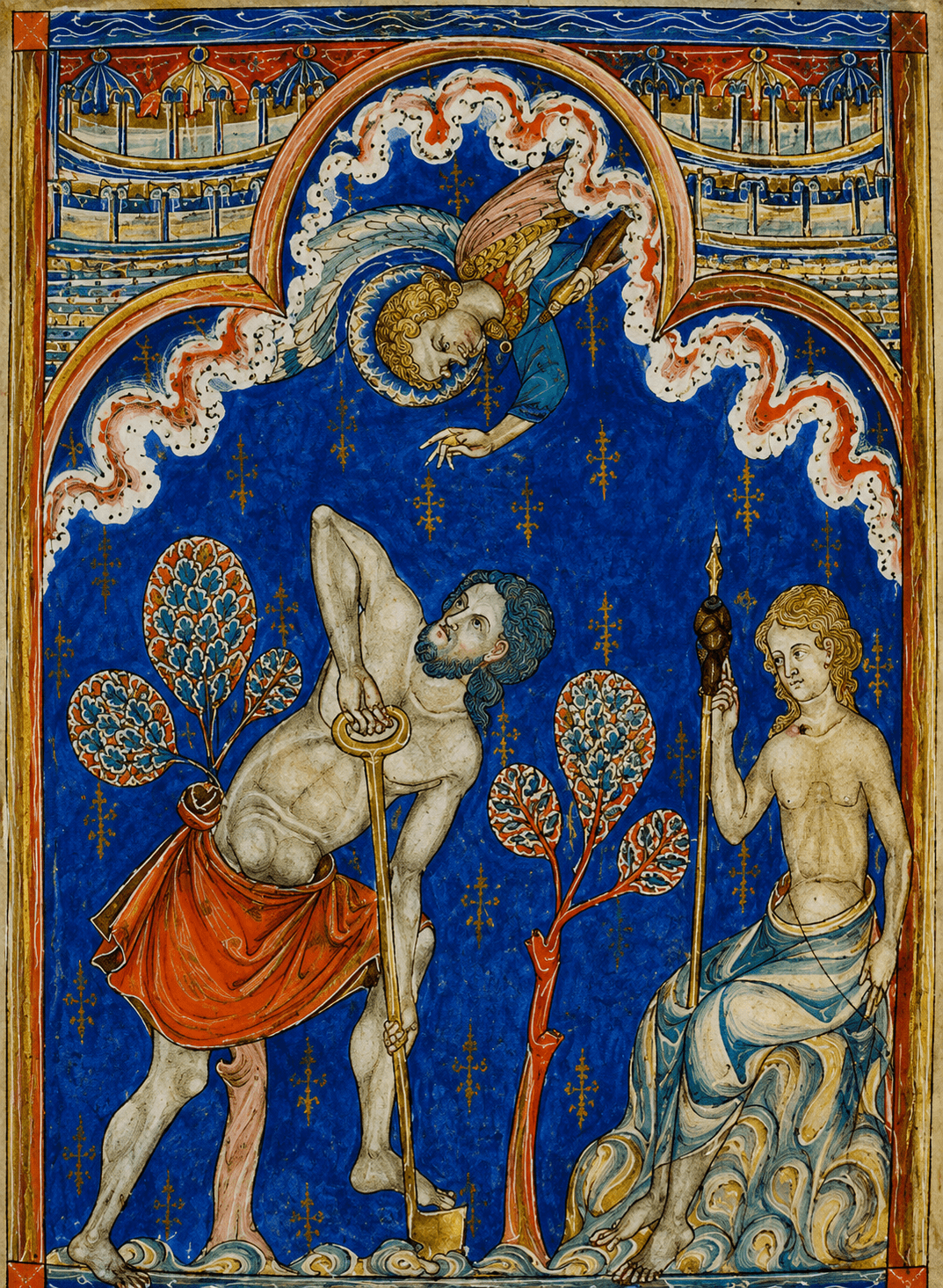
It is unknown if Adam tipped the psychedelic brew (probably made by Eve, since in the neolithic the women who did the brewing). However, in a flash of the imagination (or ecstasy), and in a quest to lighten his work, Adam crafted the rose bush into a plow and attempts to pull it himself. The labor is too difficult. Then an ox appears and offers its strength, allowing Adam to plow the soil.
Adam is implementing knowledge he brought from another realm. He is crafting technology from that memory.
The Harran story belongs to a much larger family of Jewish and Islamic Adam traditions in which agriculture, and even the plow and other tools, were not invented independently by humans, they were revealed from Heaven.
Usually, it is the archangel Gabriel doing the revealing.
In the Starwalker story, Harran therefore becomes another threshold: the place where knowledge from heaven is planted in the Earth.
At Harran, legend says Eve brought the first grain of wheat from Paradise. Archaeology places this region close to the birthplace of cereal cultivation, while Brian Muraresku has raised the provocative possibility that the earliest cultivation of grain may have been intertwined with ritual fermentation and visionary experience.
Thousands of years later, the mystery traditions would still present sacred grain not simply as food, but as a vehicle of transformation. There is an extraordinary parallel between Eve's heavenly grain at Harran and Demeter's sacred grain at Eleusis.
Perhaps the ancient stories about the gods teaching humanity to cultivate grain preserved more than the memory of agriculture. They may have preserved the memory of a sacrament.
And in my continuing search for that sacrament I am traveling to Turkey.
About William Henry
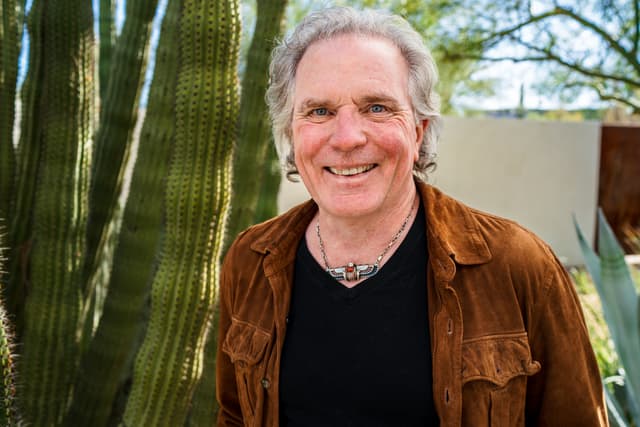
William Henry is a Nashville-based author, investigative mythologist, and TV presenter. He is an internationally recognized authority on human spiritual potential, transformation and ascension.
He has a unique ability to incorporate historical, religious, spiritual, scientific, archaeological and other forms of such knowledge into factually-based theories and conclusions that provide the layperson with a more in-depth understanding of the profound shift we are actually experiencing in our lifetime.