Magdalene's Hair
The Lost Secret of Her Robe of Light
Mary Magdalene’s long, flowing hair became one of the most recognizable elements of her image in Western Christian art—but its meaning is layered, and much of it comes from later tradition rather than the New Testament itself. In the Gospels, Mary Magdalene is never actually described as having long hair. So, why is Mary Magdalene’s hair so long and why is it red?
First, the red. Magdalene's hair frequently isn't simply red. It occupies the spectrum between: red, copper, amber and gold. This suggests her hair symbolizes her transformation from earthly to heavenly being.
The starting point is the Gospel of Luke 7:36–50. An unnamed woman approaches Jesus, wets his feet with her tears, wipes them with her hair, kisses them, and anoints them with perfume from her alabaster vessel of ointment. Jesus proclaims her act as one of extraordinary love, forgives her of her sins and sends her off in peace.
Artists then increasingly gave her exceptionally long, loose, often golden, auburn or reddish hair. Her hair looks like fire because Magdalene herself has become aflame with divine love.
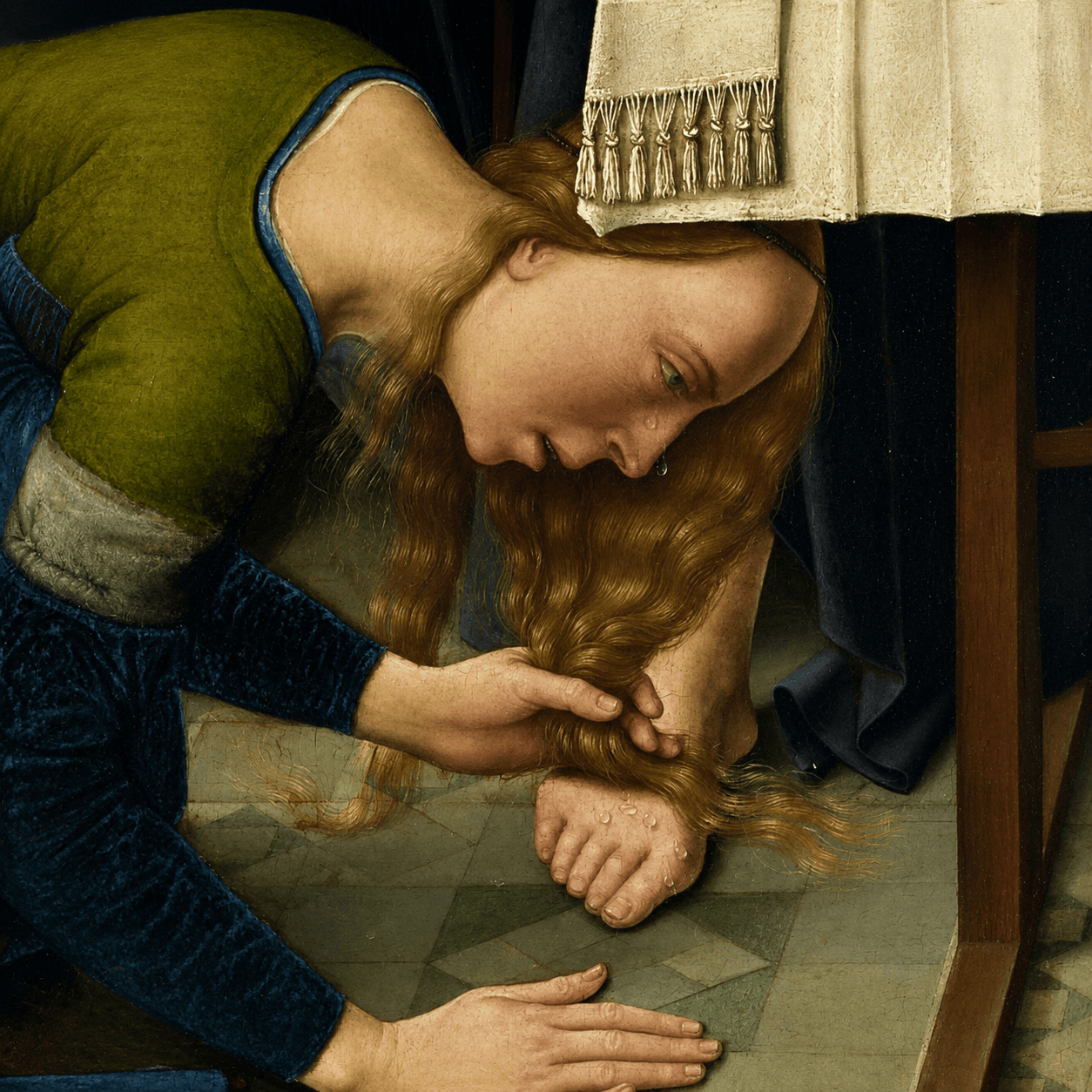
Reading the literary correspondences, Pope Gregory the Great famously synthesized Magdalene with the mystery woman of Luke and Mary of Bethany, reinforcing this composite identification in a sermon in 591. Modern biblical scholarship generally distinguishes these women.
That conflation produced the familiar Western Magdalene:
Woman + perfume vessel + flowing hair + repentance + intimate encounter with Christ = Mary Magdalene.
But then something much stranger happens.
Once the tradition was established, the hair acquired its own symbolic vocabulary.
In Jacobus de Voragine's 13th-century Golden Legend, after Magdalene withdraws into the wilderness for thirty years, her clothing eventually deteriorates. The place deliberately lacks water, trees, herbs, and therefore normal sources of food. The text explains why: Christ intended her to receive “refection celestial, and no bodily meats.”
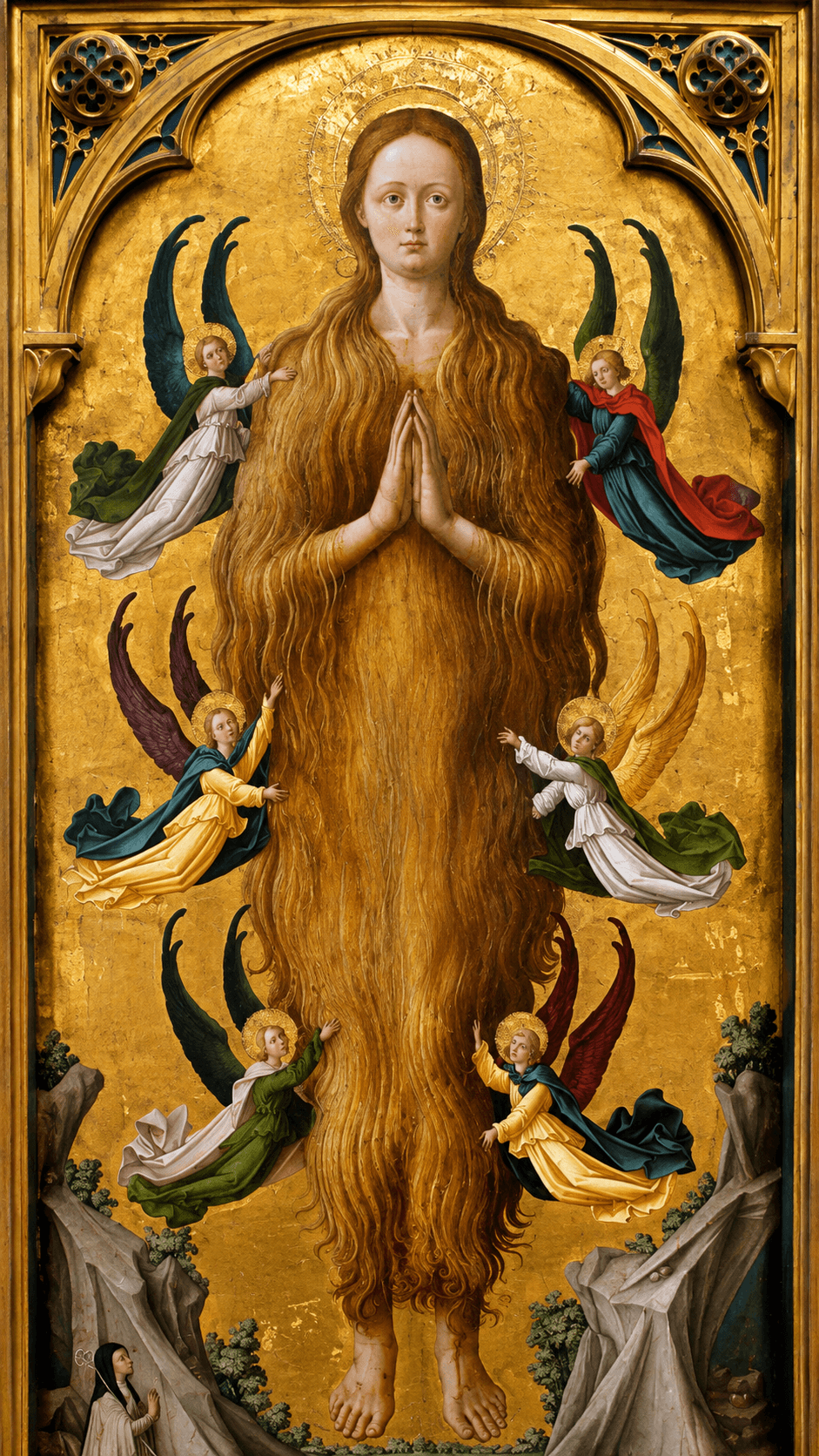
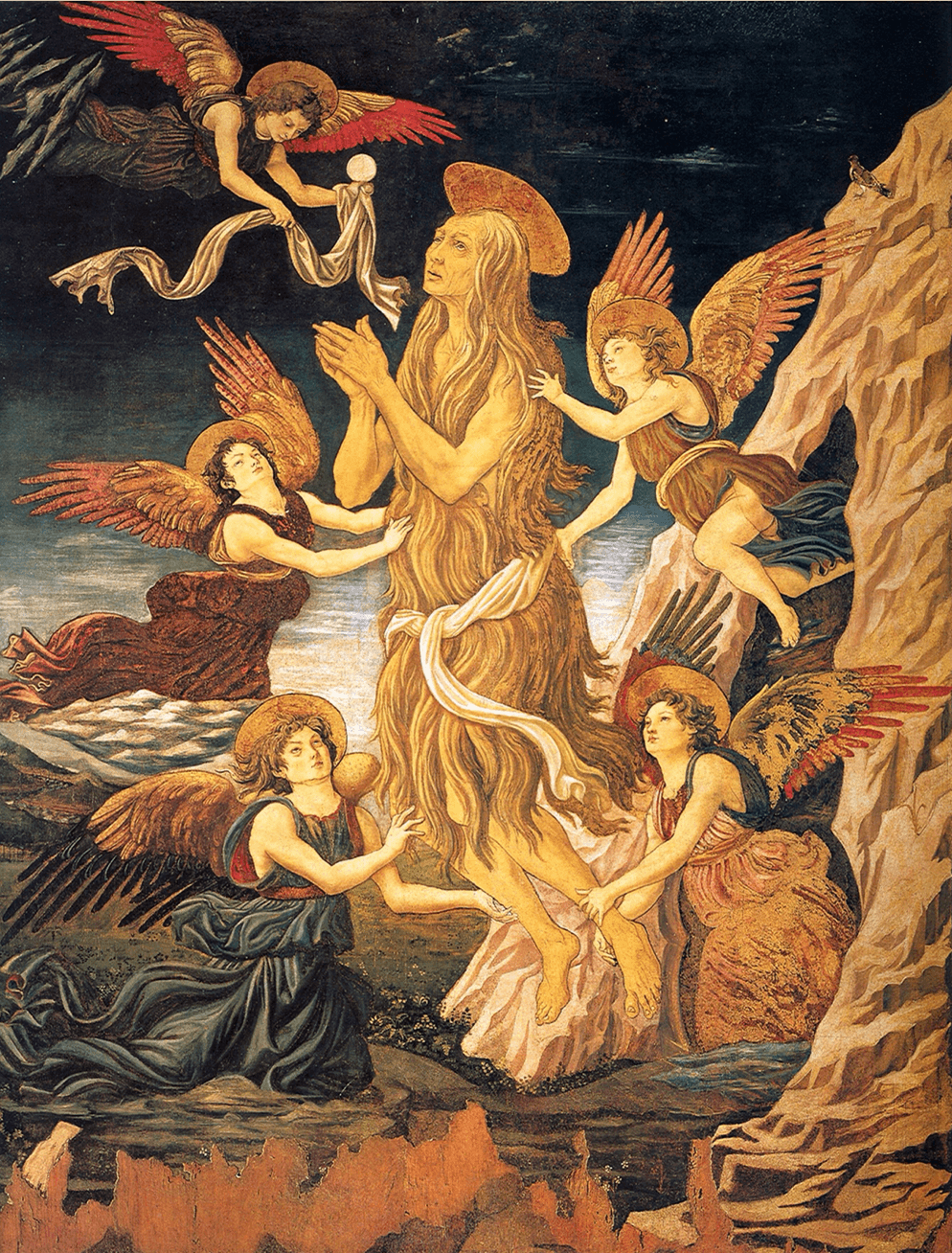
At each of the seven canonical hours of the day, angels lift Magdalene bodily into the air. There she hears the song of the heavenly hosts with her physical ears. Through this experience she is “fed and filled with right sweet meats,” after which the angels return her to her hermitage. She consequently requires no ordinary physical nourishment.
During this time, her hair miraculously grows long enough to cover her entire body.
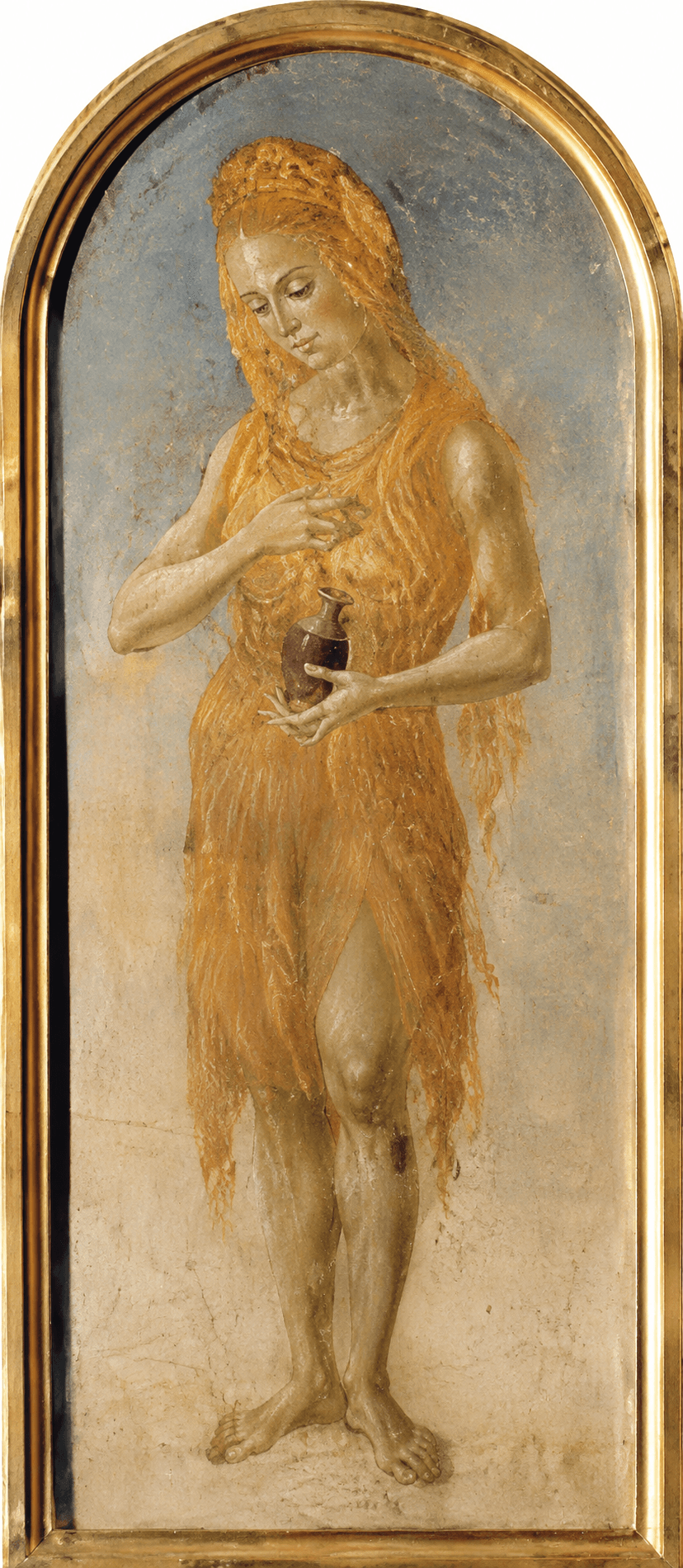
Artists consequently portray her almost as though she is wearing a garment made of golden hair. In some paintings it becomes almost luminous—an extraordinary golden mantle surrounding her body.
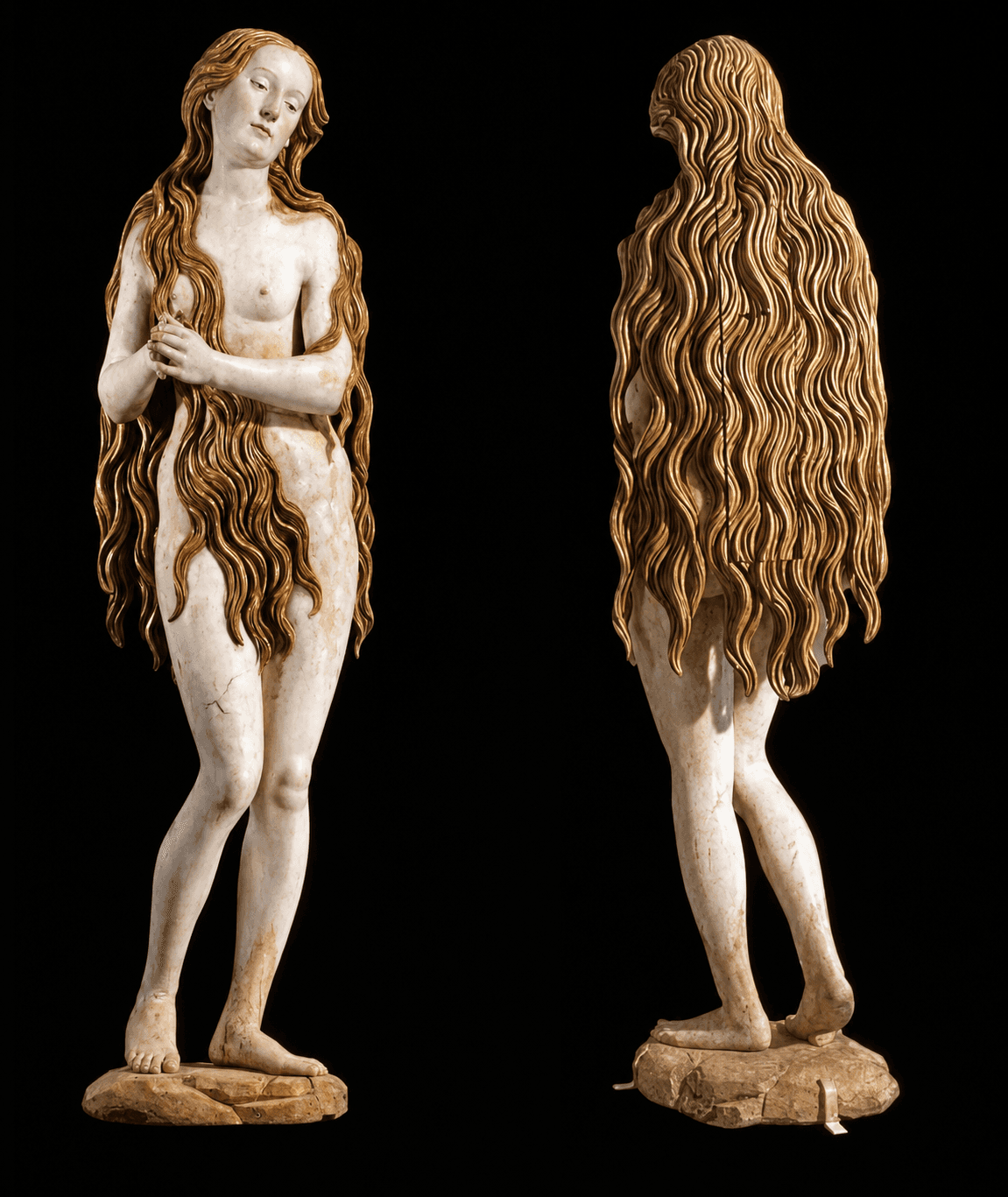
Long, unbound hair could signify the abandonment of ordinary social identity. Respectable women were conventionally represented with their hair arranged or covered; Magdalene's loosened hair therefore visually communicates that she has stepped outside conventional worldly status. In penitential images, she has abandoned jewelry, elaborate clothing and social rank. Hair becomes almost her only garment.
Something especially interesting happens in medieval images of the Magdalene.
Her hair sometimes becomes so extraordinarily long that it effectively turns into a robe.
The Angelic Star Food
According to later legends—particularly traditions gathered into the Golden Legend—Magdalene withdraws into the wilderness after Christ's ascension and lives as an ascetic. Her clothing disappears, her hair covers her body, and angels repeatedly raise her into heaven, where she eats the angelic star food and hears the celestial choirs.
That is where I think the imagery becomes especially relevant to my Starwalker interpretation of MM. Remember, I believe Philip’s mention that she was among three Marys who always walked with the Lord’ meant that she ‘star walked’ with the Lord. They are star travelers, like Enoch.
The Gospel of Mary is especially powerful for a further Starwalker reading because Mary Magdalene is presented not primarily as the repentant woman of later Western tradition, but as a disciple who possesses direct knowledge of the soul’s ascent.
Mary exhibits several characteristics central to my concept: visionary perception, knowledge received beyond ordinary sensory consciousness, passage through cosmic powers, liberation from material constraints, and return with knowledge for others.
In later medieval legend, especially the Golden Legend, Mary herself is repeatedly lifted bodily into the heavens by angels, receives celestial nourishment, hears heavenly music, and returns to Earth.
And medieval artists eventually portray her wrapped in an enormous golden garment of hair while angels carry her upward.
Angel Food and the Light Body
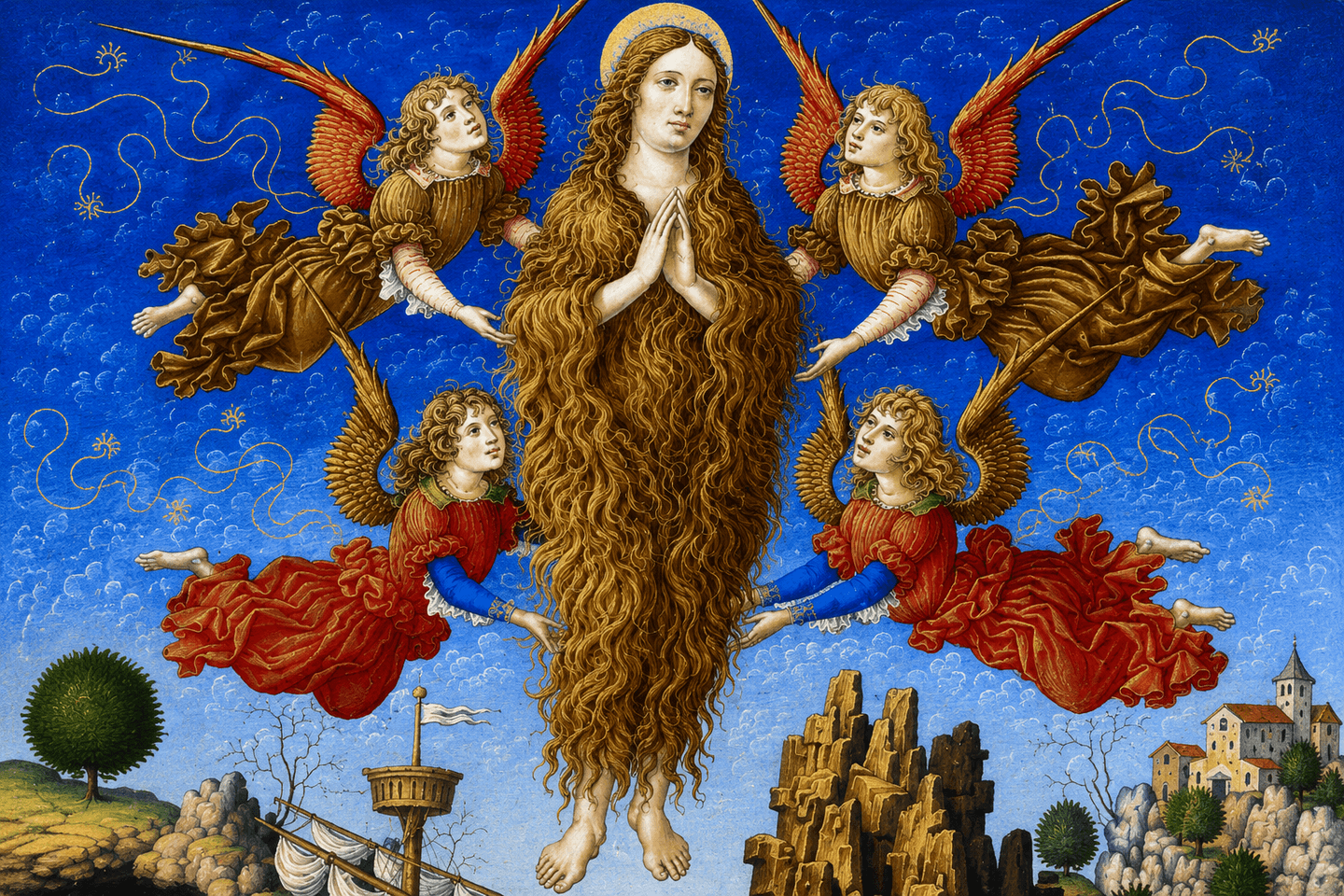
In the Golden Legend, angels repeatedly lift Mary Magdalene bodily into the air, where she hears celestial praise and the glorious chants of the celestial hosts before returning to earth. There's an even more interesting Eucharistic connection. The Golden Legend elsewhere uses very similar language about manna.
Manna is described as “meat celestial” and “bread of angels,” which prefigures the Eucharist—the “living bread which descended from heaven.”
Could this mysterious “celestial nourishment”—the food of angels that replaces ordinary bodily food—preserve the memory of an initiatory sacrament capable of profoundly altering consciousness? I discuss this further in my book, “The Psychedelic Christ : The Lost Dose of the Son of Man".
At the end of her thirty-year retreat, Magdalene's repeated encounters with the angels, and imbibing of the star food, have affected her appearance. When St. Maximin finally encounters her, the Golden Legend says that because of her habitual visions of angels, “the cheer and visage of her shone as clear as it had been the rays of the sun.”
Magdalene becomes a human being who repeatedly ascends, experiences another realm through her bodily senses, receives nourishment there, returns, and eventually manifests luminosity.
She is effectively portrayed as a traveler between heaven and earth whose transformation is sustained by repeated celestial encounters—a fascinating medieval analogue for your Starwalker motif.
Sister Golden Hair, Surprise
I would describe the Starwalker reading this way:
Mary Magdalene's flowing hair becomes the outer sign of an inner transformation: the earthly garment falls away, and the initiate becomes clothed in a living mantle of divine presence.
Finally, there is this…
In Judges 13–16, Samson's long hair is explicitly connected to his status as a Nazirite consecrated to God. The text explains his supernatural strength through that consecration: “a razor shall not come upon his head” (Judges 13:5), and Samson later says that if his hair is shaved, his strength will leave him and he would become like an ordinary man (Judges 16:17). So historically and textually, hair = consecration, covenant and divine power.
The solar interpretation becomes intriguing because Samson's name, Shimshon, is closely related to Hebrew shemesh, “sun.” Scholars have therefore long discussed whether elements of the Samson cycle preserve older solar imagery or mythology. His birthplace and burial region are also near Beth-Shemesh—“House of the Sun”—which makes the association even more provocative. Some mythological interpretations have consequently imagined Samson's locks as solar rays, meaning he is luminous or radiant. He is cloaked in a light and this cloak gives him supernatural abilities.
It seems as if Mary Magdalene is repeating this cycle.
The birth of Samson is one of the strangest and most symbolically charged birth narratives in the Hebrew Bible. It appears in Judges 13, and unlike many biblical heroes, Samson's story begins before conception. His barren mother is visited by a mysterious luminous/divine visitor who tells her she will bear a son. The child is to be a Nazirite from the womb. His extraordinary hair isn't simply magical hair in the folk-tale sense. It is the visible sign of a covenantal state. He is a divinely altered human.
Samson's extraordinary power is not described simply as muscular strength. Again and again Judges says:
“The Spirit of the LORD came mightily upon him.”
The divine ruaḥ activates extraordinary capacities within him.
The activation of his super abilities is symbolized by his flowing hair.
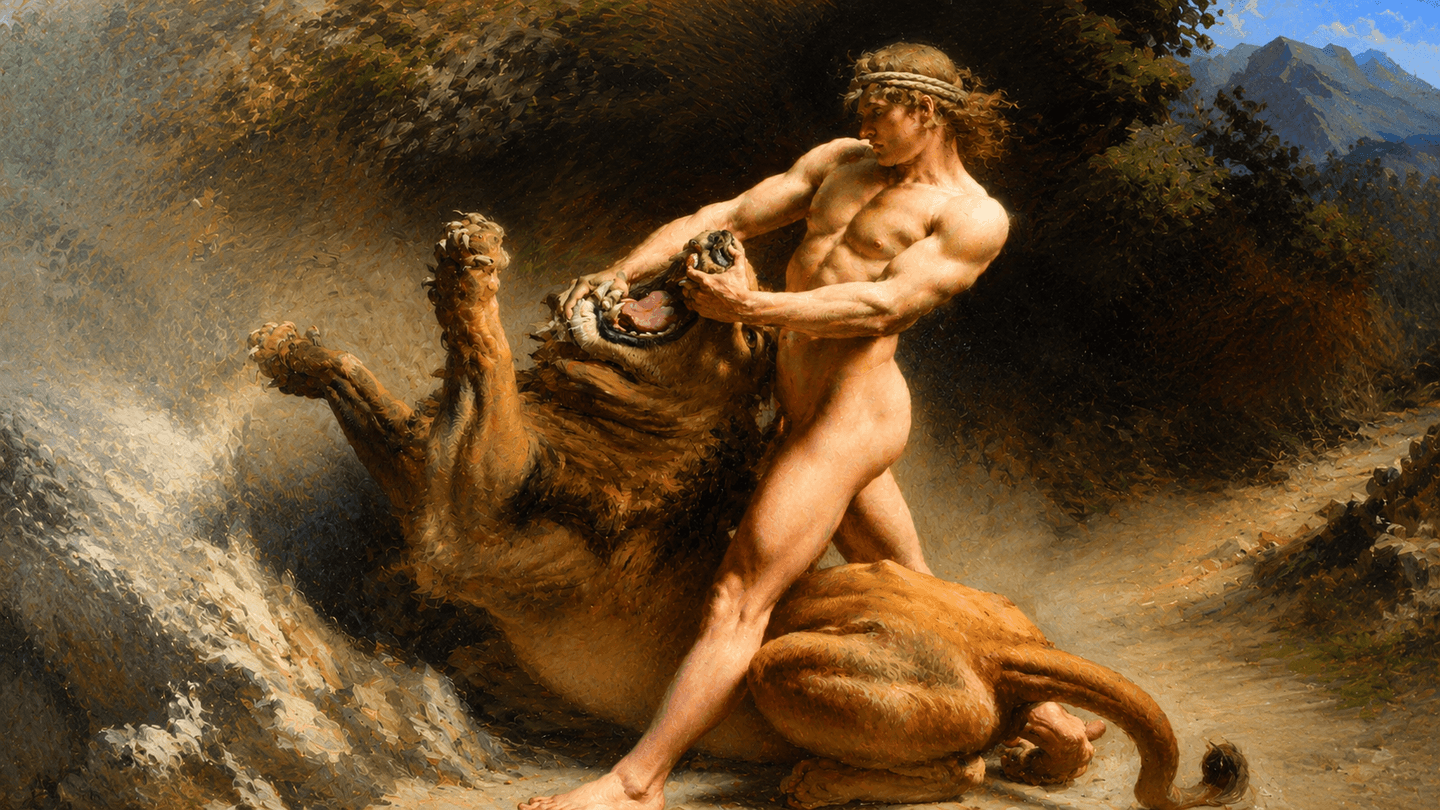
Where this gets much more interesting for our Magdalene question is the broader symbolism of hair as radiance.
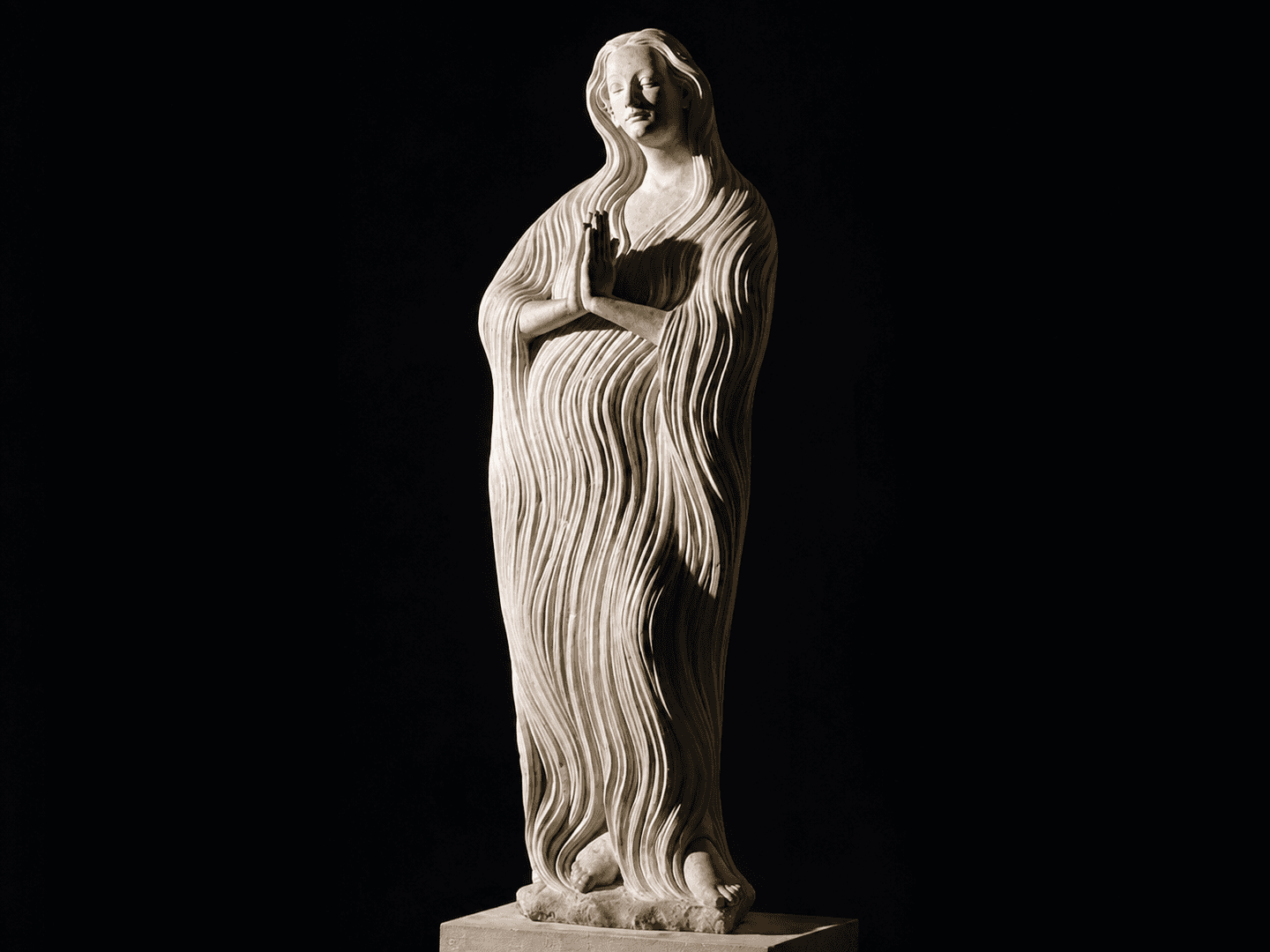
Across religious art, the boundary between hair, rays, halo, flame and luminous garment can become remarkably fluid. Long hair radiates outward from the head; the halo does the same symbolically. Both can visually express something emanating from the person.
And this gives us a fascinating comparison with the Magdalene statue above. Her extraordinary hair doesn't merely hang from her head—it envelops her entire body like flowing waves. In later Magdalene legends, her miraculous hair becomes her covering during her wilderness existence, while she is periodically elevated by angels into celestial realms.
In this interpretation, the flowing hair is flowing waves of light. She has returned to her divine essence.
Perhaps this is the lost secret hidden in Magdalene’s hair. What begins as the unbound hair of the mysterious woman at the feet of Jesus becomes, across centuries of Christian imagination, a flowing red-gold mantle surrounding the Magdalene’s entire body. She abandons ordinary life and ordinary clothing. Angels lift her between worlds. Celestial nourishment replaces earthly food. Her face begins to shine like the rays of the sun. The hair has become a robe; the robe has become light. In the Starwalker reading, Mary Magdalene is no longer merely wearing her glory. She has become it.
Follow the Golden Thread.
About William Henry

William Henry is a Nashville-based author, investigative mythologist, and TV presenter. He is an internationally recognized authority on human spiritual potential, transformation and ascension.
He has a unique ability to incorporate historical, religious, spiritual, scientific, archaeological and other forms of such knowledge into factually-based theories and conclusions that provide the layperson with a more in-depth understanding of the profound shift we are actually experiencing in our lifetime.
Related Articles
From Dust to Spice
On Arrakis, spice hidden in the desert dust expands consciousness and enables humanity to travel between worlds. But Dune also warns that extraordinary powers, extended life and technological enhancement are not the same as spiritual transformation.
From Dust to Light
Humanity was formed from earthly dust and animated by divine breath. As carbon bodies become increasingly integrated with silicon intelligence, can technology help awaken our latent capacity for transformation—or will it merely create a convincing simulation of the human light body?
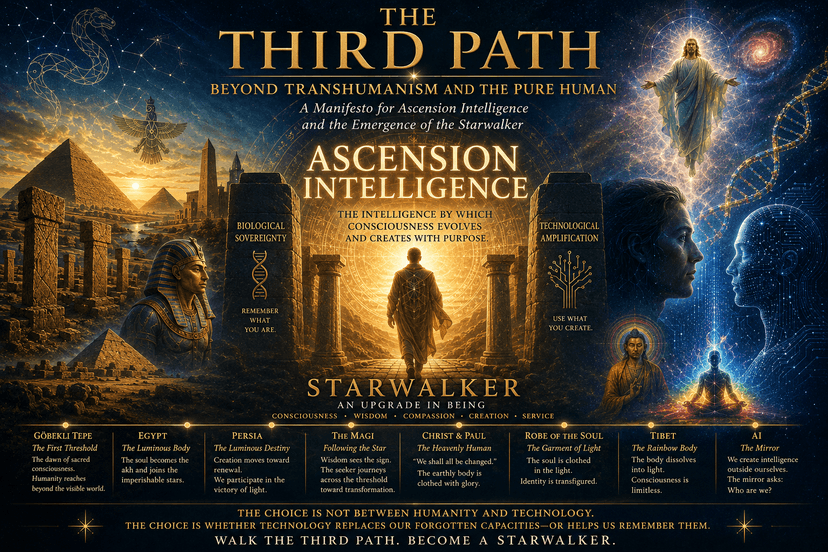
The Third Path
Humanity is being offered a false choice: remain biologically “pure” or merge with our machines. There is a Third Path—one that uses technology without surrendering to it, awakens the latent capacities of the human being, and points toward an ancient possibility: the emergence of the Starwalker.